AMinecraftMovie’shappyendingisatoddswithMinecraftitself

A Minecraft Movie isnt exactly indelible cinema for the ages, but its a massive box office hit — and a charmer, in large part due to Jack Blacks endlessly frantic energy and Jason Momoas absolute go-for-broke willingness to be the butt of every joke. Its aimed both at an audience that grew up with Minecraft and the audience thats invested in it right now, so its a pretty typical brand extension, packed with “heres that thing you liked, but in another medium” references for the fans and “live-action” (well, CG, primarily) literalizations of creatures, settings, scenes, and activities from the game.
But director Jared Hess and the five credited screenwriters took an approach with A Minecraft Movie thats rare for game adaptations: Instead of setting the story entirely within the games world (like, say, The Super Mario Bros. Movie or The Last of Us or Arcane or Secret Level or, sigh, Borderlands), they send people from our world into the game, and present it as a wonderland where anyone can easily create whatever they want. And that has odd implications for the movies ending — implications that collide with what seems to be Hess and companys mission statement.
[Ed. note: Spoilers ahead for A Minecraft Movie.]
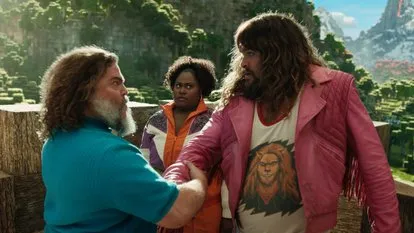
Image: Warner Bros. PicturesA Minecraft Movie centers on Steve (Jack Black), a cheery doofus who stumbled into Minecrafts Overworld and reshaped it according to every whim that crossed his mind; Garrett (Jason Momoa), a puffed-up former 80s arcade champ who now runs a failing games/electronics/odds-and-ends store in Chuglass, Idaho; and Henry (Sebastian Hansen), a recently orphaned high schooler whos constantly doodling new inventions in his notebook, but gets mocked at school for his imagination. Henrys beleaguered older sister and newly appointed guardian Natalie (Emma Myers) and local Chuglas real-estate agent and mobile-zoo owner Dawn (Danielle Brooks) also get sucked into the Overworld action, but dont get as much face time or story-arc energy.
Together, the collection of misfits has to fight a threat from the hell dimension The Nether to save the Overworld, and collect a MacGuffin that will let them get back to Idaho. But first, they need to frantically run around the Overworld, fighting piglins and zombies and a Chicken Jockey, learning how to craft items, trying to save Steves pet wolf Dennis, and generally poking at various aspects of the Minecraft experience.
And they need to learn life lessons. Garrett learns how to be vulnerable and drop his swaggering pretense of superiority. Steve learns to accept other humans as friends. Henry learns that some people actually like it when he crafts stuff. Natalie and Dawn learn that they are absolutely welcome to be physically present while all this character development is happening.
Image: Warner Bros. PicturesWhen the characters reopen their portal back to Earth, theres a big emotional isekai moment where they decide who actually wants to return. Steve, who has constructed a vast playground for himself in the Overworld, plans to stay behind. And he gently suggests Henry should too, because Henrys barely scratched the surface of the Overworlds creation tools and construction possibilities.
But Henry says nah, hes gonna head back home and get back to work on the jetpack he was building before the local bullies sabotaged him. Seeing his new friends leaving, Steve dithers, strains, and finally decides to go with them. So he heads back to Earth, where he lives in a tiny crackerbox house (or doesnt, since its apparently been sold off), doesnt have a job, and never felt connected to anyone. But now he does have people to sing karaoke with and design arcade games with. Cue the happily-ever-after montage.
Theres no shadow over any of these choices, no debate about whether Steve and Henry did the right thing: Their decisions immediately bring them joy, fulfillment, and connection. (And, in Steves case, money and acclaim; in Henrys case, the gasping adoration of girls his age.) But that leaves us with a pretty overt set of takeaways about Minecraft — namely, that building stuff in the real world is cooler and more important than building stuff in a video game, and that hanging out with friends in the real world is more satisfying than constructing or exploring in Minecraft.
That isnt at all a bad message. Its pretty wholesome, as mission statements in brand-extension movies go! But A Minecraft Movie cant actually say any of this. Neither Henry nor Steve in any way articulates the whys of their choices, or makes any statement that might suggest that leaving the Minecraft world behind in favor of the real one means anything to them, or should mean anything to the viewers.
Image: Warner Bros. PicturesThat might not land so oddly, except that Garrett gets a big speech to explain his own epiphanies to the audience, and talk about what hes learned about himself and how hes changed. Hes the only character who gets that opportunity, because hes the only one of them who can spell out what his adventures meant to him without touching on whether this blocky world full of item recipes and unlockables is alluring to him. (Also, hes spent the entire movie getting the crap kicked out of him, and the urge to leave that behind seems pretty sensible.)
For everyone else, though, its downright odd that the movie lets them spend almost no time considering whether they might want to stay in a Technicolor fantasy world where they dont have to worry about jobs, mortgages, or zoning laws prohibiting them from building an entire damn theme park in their backyards. Viewers could certainly make up reasons why Steve and Henry might find the real world more tempting, but they certainly arent on the screen.
And given that every single one of them (plus most of the other adults in the movie who get more than two lines!) is dealing with financial anxiety and the looming threat of poverty, youd think theyd at least consider whether they want to stay in this new dimension, where diamonds are easy to mine and the land and food all seems to be free. Even if the nights are full of roaming monsters and the days occasionally feature a despotic sorceress trying to rule the world, the Overworld should still be something of a draw for characters this rootless, disconnected, and struggling.
The fact that it isnt a temptation only feels odd because they dont address why — because they cant, not without in some way dissing Minecraft by implication. If Henry were to outright say that building a real-world machine means more to him than constructing a Minecraft castle or amusement park or creeper spawner of his own, or if Steve admitted that hed rather have friends than a block kingdom, that might come across as a knock on the brand, an admission that there might be something missing or less-than about the Minecraft experience. And that clearly cant happen in a Minecraft movie — especially when leaving the Overworld behind so clearly brings these characters what they need.
Image: Warner Bros. PicturesIts even more odd that they never once address the idea that they can return to the Overworld anytime they want. They have both their portal MacGuffins in hand — Steve shouldnt even be in conflict about heading back to Chuglass, since he can return to his elaborate builds and secret treasure hoards whenever he feels the “First we mine, then we craft!” urge. In that way, hes just like any other gamer who has Minecraft at their fingertips.
This missing aspect of the ending isnt a real or significant knock against A Minecraft Movie. The film is largely just a goofy, lightweight ramble through a virtual world with some pretty shallow characters engaging in broad Looney Tunes comedy. Hess and company werent required to slip in analytical criticism of the product theyre putting on the screen. (Although that can pay dividends — Greta Gerwigs Barbie is a full-on cultural and box office phenomenon, even though its openly conflicted about the Barbie brand and its legacy.)
But when it comes to brand-extension movies that are openly about how fictional characters interacting with a familiar product does and doesnt bring happiness, its hard not to think of Phil Lord and Christopher Millers The Lego Movie. That film is also silly, fun, broad, and slapsticky. But at the same time, it concludes with a meaningful treatise on how to play with Legos “correctly,” for maximum joy, engagement, and family interaction. And Lord and Miller manage that deconstruction both without insulting Lego and without insulting their audience.
A Minecraft Movie feels hesitant and squeamish by co复杂情感ast — not because it doesnt go as far into the meta realm of addressing how the characters are avatars for the intended audience, but because the script strolls riiiight up to the edge of that construction, then squirms awkwardly away without making any of the connections the writers hint at. It gets almost all the way there, but the urge to respect and praise Minecraft is directly at war with any urge to address what interacting with it means to the characters, their ambitions, or their futures. That conflict winds up front and center on the screen, but it isnt resolved; its just ignored.
The movies most relatable idea, the one most designed for audience appeal — and the heart of any isekai story — lies in the framing of real-world people getting to go somewhere magical. In this case, players who love to build things get to hang out in a world where they can physically do everything that gamers only get to do virtually. Thats a fun and tempting scenario, particularly for people whove devoted hours upon hours to Minecraft. In dodging the question of why anyone would want to leave that all behind, the team behind A Minecraft Movie leaves its ending feeling a little unfinished, like something it started to construct, then wound up leaving behind.
